
Asides from generally just wanting to be known as a good guy in my industry, one thing I strive to be renowned for is my attention to detail with my patients and clients.
I am now entering the 14th year of my career as a Therapist and to be honest, within these years I truly believe I have kinda “morphed” into a some sort of Therapist/Trainer/Coach “Hybrid!”
The reason I say that is because my continued “therapy learning” has never stopped and has in fact crossed many boundaries into the athletic training world. On top of all of this, I’m learning to be more than “just an “injury therapist”. I’m learning to become an all-round “Coach” to my clients. The same can be said for my business partner Jon, who I work with and learn from on a daily basis as well as Ollie, Jayne and now Tom (Hi Tom!) who are keen learners and avid students when we hold our weekly In-Service Training sessions.
We find ourselves now designing programmes and implementing strategies for our clients that take into consideration their entire lives, lifestyles, habits and stress. We no longer tend to see them for an hour and say “see you next week”, rather in fact, we find ourselves looking at the other 23 hours in their day and 167 in their week to see how we can get the best out of their health, fitness and recovery. We do this because the truth is, we know we can control their hour with us, that’s the easy part! The hard part is educating our clients to make better decisions, build healthier habits and enable them to create a better environment in which they can live, be happy and healthy. By doing so, we can effectively fight off the disease riddled world that is modern society! As my business partner Jon often says “Anyone can work you out, not everyone can make you better!”. Replace the words “work out” with “give you rehab” and the same can be said in the therapy world!
At Tier 1, we often get patients being referred to us off of the back of our other patient’s success stories. I’ve recently been very affectionately coined “The fixer of the unfixable” which I have to say was lovely to hear but made me feel a bit awkward! The reason I say that is because, I truly believe I am not the most talented therapist out there. In fact, I know I am not. However, I DO believe that I learn from the very best in the world. Having travelled extensively the world to learn from the very best, as well as being an avid reader, I believe I simply put the work in and “make my own luck” when it comes to treating my patients successfully. At Tier 1, we simply study the best, learn from them and apply what is applicable to our patients and clients. Hard work and passion, that’s it!
So what separates us from the rest and what are the real drivers behind the problems that we see in our clients?
This is a difficult one to answer but honestly, I think it’s our attention to detail. I truly believe that, unless you go to the places and visit the incredibly clever individuals who taught us, you won’t find any current concepts or a level of thinking that compares. Nor will you find an assessment protocol or system that enables you to restore lost movement, shut down pain or improve strength and conditioning like the one that we have adopted. One I might add, that we continually personalise through both evidence and experience.
So what is it that we pay such close attention to at Tier 1?
Well, that’s simple really. Everything. As mentioned earlier. There is 168 hours in a week in which the human brain and body can encounter potential problems. We need to pay attention to that. During those 168 hours, we encounter stress, we have to breathe in excess of 20 thousand times a day, we have to eat, sleep and move. ALL of this can have profound implications on you, how you experience pain or your ability to perform in life or in competition.
Now by far the biggest areas to pay close attention to are, position, breathing and stress. It is in these 3 key areas that you can win or lose the battle with pain, movement, and performance. It is these 3 key areas that we pay such close attention to and in my opinion, this is what separates us at Tier 1. This is because in the world of therapy and performance, there is still way too much focus upon isolating joints and muscles, seeking a “singular diagnosis” and then applying dated rehab concepts such as foam rolling and muscle activation exercises in rehab and training programmes.
Now I’m not here to beat down on anyone, so let’s just focus on what happens at Tier 1. Firstly. we don’t just look at bones, ligaments and muscles, we look at you as an entire “system” in which your brain and central nervous system are powerful information processors that regulate, monitor and ultimately decide how you breathe, move, act and experience powerful “problems” such as pain, stiffness, tightness and even illness. This is often a huge concept for our patients to come to terms with. That their brains are the “King/Queen” of a huge network that rules their bodies. For us to be truly successful in fixing people, we must understand and be able to work with the brain and not just muscles!

So let’s take a look at the key factors that influence the brain and the body:
- Position is King!
- Position and Breathing
- Stress & Position
For you to make sense of what we do and how we truly fix people, we need to discuss the importance of position!
The Power of Position!
Position is probably the most important and overlooked factor/variable/issue (whatever which way you look at it!) in most physical therapy, sports therapy or training assessments and programmes!
Now this could be for many reasons but in my experience, it’s because position is so misunderstood and holds such little value when compared to areas like strength and “how active” muscles are.
Now don’t get me wrong, strength is key and I’ve got nothing against muscle activation techniques but what if I told you right now that when it comes to strength and muscle activity, position is 9 tenths of the law!
The reason for that is simple, the position of your pelvis, rib cage and spine all have a direct effect on muscle length and tone. Muscles attach to your bones via tendons, we all know this. What a lot of people don’t seem to consider however is that if the bony attachments at either end of the muscle are placed closely together, that enables the muscle to be shorter, “positionally engaged” and strong.
Alternatively, if those two attachment points are placed further away from one another, the muscle becomes longer, weaker and its ability to influence position is reduced. Think about it this way, if you place an elastic band in your hands and pull it apart, it becomes longer, weaker and more taut. Bring your hands together and it becomes shorter and stronger. The position of your hands dictated the strength and power of the band. The same is true in the body.
This therefore begs a question:
Why do we STILL place such a heavy emphasis on strength and muscle activation work without first considering POSITION in our Assessments and Programmes?
Surely if position directly influences a muscles strength and its ability to engage, it takes precedent in our line of work?
I see it on a daily basis with the athletes and general populations that I work with. They spend hours of their time foam rolling out “tight muscles” and then go onto trying to “activate” their quads or their glutes with band walks etc. They then report that they feel good only for me to see them the very next day having to go through the same old ritual because they feel “tight” again.
Surely with all that foam rolling and muscle activation work on a daily basis, their muscles would have loosened off or woken up by now right??
WELL WHAT IF WHAT THEY WERE DOING WAS WRONG???
What if their muscles are not actually tight? What if muscle activation wasn’t really the solution?
What if the underlying solution was right under their noses this whole time? POSITION!
We need to come away from this whole perception that muscles become “active or inactive”, or perhaps even worse, “short and tight” if we don’t stretch to lengthen them. Our muscles are not conscious beings, they do not independently decide to “switch off or on”. The overwhelming research now indicates that those muscles instead become engaged through position. Let’s take our hamstrings for example, most of people perceive their hamstrings to be “short and tight”. They therefore believe that they need to be stretched out. Seem logical right?
Well what if I told you right now that those hamstrings were in fact being placed on length through POOR POSITION?
Yep, you got it, that muscle you’ve always thought to be short and tight, is in fact, long and taut! You see, your hamstrings are not tight in the sense that you think they are! They may feel tight yes, but they are being placed on length because their two bony attachment sites are being placed further apart through a sub-optimal position of your pelvis. Therefore what you are experiencing is a “perception of tightness”.
So this begs another question, does a muscle that is being placed on length require endless foam rolling and muscle activation work? OR does it require an exercise that restores better position by moving the two bony attachment points closer together? The latter right!!?
Right! By placing the pelvis in a better position, we will move the attachment points closer together. In doing so, we will take excessive length and tension off of the hamstrings and allow them to be placed on a more normal length. This takes away the perception of tightness but BETTER YET because they are now able to operate from a better position, they can now produce more strength and power. And if that wasn’t enough, by placing the pelvis in a better position and taking the hamstrings off length, your “flexibility” will massively improve! All of this means your risk of pain, injury or problems will significantly lower and your natural athleticism will improve!
Sounds crazy doesn’t it…by moving the attachment points closer together you can drastically improve “flexibility”…all without stretching!
If you are struggling to visualise this, take a look at the diagram below.
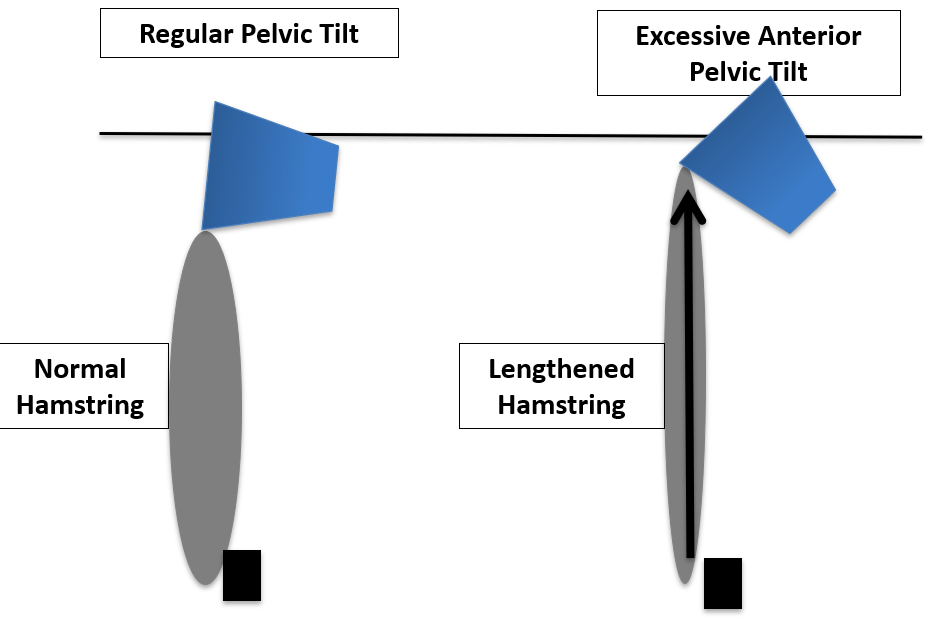
As you can see, the pelvis on the left is in a good position meaning the hamstring is in a good position. This means it can engage and will be strong (think about the elastic band). The pelvis on the right however it tipped forward and in a sub-optimal position. This means the hamstring on the right is in a lengthened position, will not be as strong and will “feel tight” due to it being placed at length.
What does this mean?
Well, typically the person on the left will not feel the need to “stretch” whereas the person on the right will be “that guy” who’s always trying to stretch, foam roll or be going to get a massage. These individuals more often than not are the guys who self “crack” their necks and backs.
Now I know I’ve just spent the entire of the last page turning your world upside down by saying foam rolling and stretching will not fix your tightness and that there is no point in trying to activate a muscle that is being placed on length! BUT, that’s not to say that they do not have their uses!
I still programme stretching into my patients routines and I do sometimes get people to foam roll! Why? Because they do hold good benefits still, maybe just not the ones they are renowned for!
Foam rolling is great for moving blood and water around the body and is a nice quick way of accessing your central nervous system to get your brain to reduce the tone of a muscle. Think about wanting your body to be a “river rather than a lake”. We want our blood and water to be able to move freely around our bodies, just like a river constantly flows. We do not want our blood or water to sit around and not be able to move freely like water in a lake. Foam rolling helps in these instances.
Foam rolling provides a good, effective means of being able to help us promote and improve circulation in the body by moving blood and water around. It also enable you to stimulate certain “pressure” receptors in your muscles and tendons which help to reduce threat levels in the brain to effectively allow you to reduce the tone of a muscle. This is a great place to start or finish your workout as by reducing tone, it will help you be able to achieve optimal POSITION more quickly.
Stretching on the other hand is a great tool to use before bedtime as it again helps to remove stress threat levels within the body. This allows you to shift into a more relaxed and restful state before you go to sleep. This ultimately boosts your recovery for the next day or planned workout! Rarely do I programme stretching heavily into my rehab or training programmes these days as I know that usually my patients require a POSITIONAL focused exercise over a muscle lengthening exercise (remember, the muscle feeling tight is not short but is probably in fact long!).
This leaves us with “muscle activation techniques. Now whilst I do not have anything against these drills, as they undoubtedly provide benefit. My issue is that they always seemed to be performed in a rush, at speed and without any appreciation for optimal position. Take lateral band walks for example, everybody seems to love these drills from footballers to rugby players to runners. “Gotta get those glutes going!” seems to be the mantra!
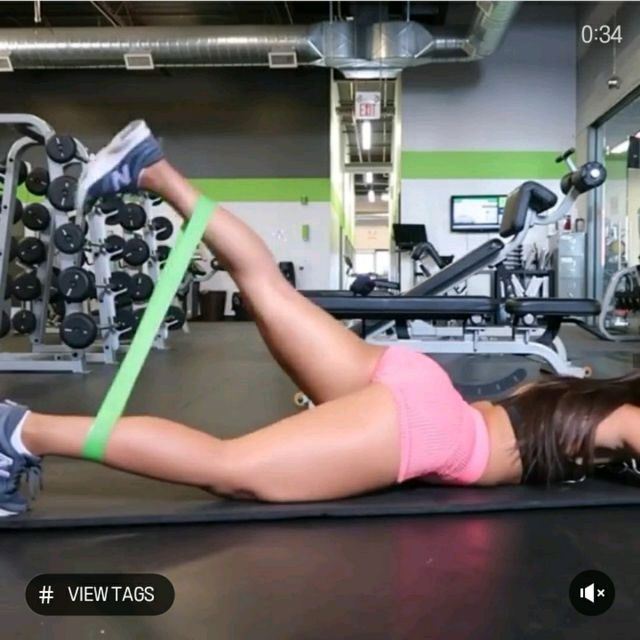
Well if that’s the is the case, then why do the majority of people allow their backs to arch, their pelvis to dump forward and completely over-stride on such banded drills If you “gotta get the glutes going” then why have you have just totally pulled them out of position to allow them to work effectively!?

The bottom line is, position forms the foundation of everything. If you want to improve strength, build off solid position. If you want to improve mobility, put your joints in their best position. If you want to move fast, position your body to be fast. If you want to slow down or change direction, allow for this first by addressing your position!
It’s like that old Bible story, is it better to build on top of sand or rocks? The stronger, better positioned foundation the better right! If you want to be more efficient, perform better, be stronger, more flexible or have muscles that are more capable of doing their job, stop chasing endless foam rolling, muscle activation drills or stretching out and start putting position at the top of your priority list!
I hope that’s all made sense up until now, please feel free to shoot away with any questions or comments at this stage, as in Part 2, I’m going to introduce you to how Position directly affects Breathing and vice versa, this is absolutely fundamental reading if you suffer from pain, problems with lower back, shoulder, neck or even issues relating to hamstrings, calves etc.
See you in Part 2! (CLICK HERE FOR PART 2)
Stu Turner
stuart@t1trainingandrehab.co.uk
 Tier 1 Training and Rehabilitation Systems
2 thoughts on “Position is King! – Part 1”