
I think it’s fair to say home workouts have absolutely exploded since the covid19 lockdown. For me that’s one major silver lining in what is for many, a huge dark cloud of worry, anxiety and uncertainty.
We live in a country that is getting bigger and less active. That’s a fact. So it’s always fantastic to see so many people getting ready at 9am to do “PE with Joe” as well as so many PT’s switching instantly to online/video based training for their clients. Getting more people moving in western society is always a win in my book. Hell, I don’t even mind celebrity DVD’s at this stage (definitely my biggest bug bear normally but I’ll save that rant for another day!) if they get you moving!

What I want to discuss today though is a quote that I really want you to think about, it goes like this:
“Anyone can work you out, not everyone can make you better”
Now this quote really resonates with me because it I believe it literally hits the nail on the head for what’s happening right now across households across the UK. There has been an absolute explosion of home WORKOUTS but what about home PROGRAMMES? I’m seeing hardly any of these! As the quote goes, ANYONE can provide you with a workout. But is that anyone actually making you BETTER?
My point is, anyone can put together a workout for you that makes you collapse in a puddle of your own sweat (or worse, vomit!). Anyone can crush your legs to the point where you have to live on the bottom floor of your house for a few days due to not being able to make it up the stairs! Anyone can do that! The question is, what did that workout actually achieve!? What was the goal of the workout? What is your goal in general!?

Now of course, if the goal of the workout was to get crushed and not be able to walk for a few days then well, HEY YOU SMASHED IT! On the other hand, what if the goal of the workout was to get stronger or lose weight? Some might argue that you burnt a tonne of calories in that ONE workout.
Well sure you might well have done! You may also have provided a message to the body that it needs to make itself stronger. After that ONE workout however, how is not being able to walk for a few days going to help you in the next workout? Or how is performing a series of workouts that place so much stress on your joints that by week 2 you cannot continue due to knee pain going to help you train consistently in the longterm? It’s not is it?
Let’s use an example:
Theresa wants to lose weight and gets told to perform a killer workout because it can burn up to 700 calories in one session, she does it, burns 678 calories (according to her FitBit!)….but can’t train for another 3 days because everything hurts too much.
Theresa then seeks sound advice and get’s given a programme to follow instead of just a workout. Next week she starts again and following day 1 of her programme, is disappointed to see that she has only burnt 302 calories. She then tells herself that the workout could not have been as good as last weeks because she’s burnt less than half the calories! Theresa is now beating herself up and tempted to go back to the first type of workout!
Theresa has now fallen into a trap.
The trap that every workout must be hard and the more calories the better!
BUT…remember, Theresa couldn’t train for 3 days after the last workout because everything hurt! On the second week, she left the session feeling GOOD!
This means that had she continued with the PROGRAMME she could easily have trained the next day and the day after that and the day after that….and the day after that no doubt!
Let’s do the math.
If Theresa can only train 2 days a week using the killer workout due to being left feeling so banged up….and assuming she burns the same amount of calories again (which she won’t as that’s not how the body works) she will have burnt around 1356 calories.
If on the other hand, Theresa is able to perform the second, more sustainable plan over the course of the entire week, she can burn around 1510 calories!

Holy cow she’s burnt more calories using workout 2 you say!?
Yep! You got it! Theresa is able to burn more calories, train more, feel better, suffer no pain. Now she is working smarter with regards to weight loss! Provided her nutrition is on point of course!
Well I never!
Why is this you ask!?
CONSISTENCY
Consistency is the driver behind your results when it comes to reaching a goal. Without it you cannot succeed. To get strong you need to train consistently. To lose weight you need to eat better and move more, consistently. To be healthier, you need to be sleeping, eating, drinking and exercising well, consistently. There are no short cuts to success. Sure, these celebrity DVDs, articles on High Intensity Training or “6, 8, 10” week transformation programmes advertised on Facebook might promise you it can be done in a short amount of time….

BUT….
They are trying to make money out you! Which means there is an ulterior motive!
And secondly, why are these quick fix packages only lasting for say 8 weeks!?
Because they are NOT sustainable! They place too much stress on you and cannot possibly be continued in the long run!
Which means as soon as you finish them, left to your own devices, you are most likely going to go back to your old ways and the results go out of the window!
Now, don’t get me wrong, I know plenty of coaches and trainers who DO use 6 week plans at the start with their clients. But they do this just to get the ball rolling, gain momentum and achieve quick wins with their clients only then to switch to a more sustainable strategy after this strict period has finished.
These guys and girls are smart. They know what they are doing and will have no doubt explained all of the above to you and EDUCATED you on why they are taking this approach and HOW its going to be done and how it’s going to help you. This means that by the time you start you are left with no doubt in your mind of the approach you are going to take.
I applaud these people.

Now ask yourself, has that guy on facebook that’s selling you his quick fix explained that to you? Is he offering a sustainable aftercare package? Or is that new reality TV star who’s trying to sell you their DVD on how they got their beach body in less than 6 weeks explaining all of this to you?
If they are not then they are most likely just trying to make money out of you. They don’t really care nor do they probably even understand any of their own product themselves.
STEER CLEAR.
The point being, a good trainer or coach will always seek to educate and empower you to understand first and then, use your new found understanding and knowledge to form your own answer to your problem. A lesser trainer or those with ulterior motives will most likely adopt a “you need this, and you need me” approach.
BUT ENOUGH OF THAT, LET’S MOVE ON!
So in order to get moving forwards, it always helps to have some golden rules to abide by. Here are mine:
Rule number 1:
Consistency is King. If you want to get results you have to commit to the LONG GAME! You only get the results you want if you are able to train without missing sessions and by being as fresh as you can going into EACH & EVERY ONE of those sessions!
Rule number 2:
NEVER judge a workout by how hard it was. That is not always the measure of a good session! A measure of a good workout is:
- Did it move you towards your goal?
- Are you going to be able to perform OK in your next session?
Rule number 3:
Consistency BEATS intensity: If you can operate at a performance level of 80% all year round, you will beat someone who operates at 100% but dips in and out throughout the year. Always. End of. Training consistently is the only way to reach your results and in order to achieve this, your workout must be sustainable and not beat you up or break you down through fatigue or injury.
Rule number 4:
You need a GOAL! What is it!?
Rule number 5:
Alongside your GOAL, you need CONSISTENCY and you also need STRUCTURE.
STRUCTURE
If consistency is the driver behind your success, structure is your satellite navigation system that maps out the roads you must take to reach your destination.
If you have your goal, have in place a structure and you are able to execute all that is within this structure consistently, you are on the road to success. It’s that simple.
Having a STRUCTURE in place creates accountability. Accountability provides the motivation. Motivation creates the drive. The drive creates CONSISTENCY. The consistency reaches the GOAL.
It doesn’t matter what your goal is, whether its to lose weight, get strong, feel better, move better or build a better athlete. You need to first have the goal, then create the structure to enable you to consistently towards that goal.
I know this sounds complicated but it really isn’t. All you have to do is ask the right question, and that is:
How do you build structure into workouts?
And the answer to that question is:
You build a PROGRAMME!
An effective programme is simply a series of progressive workouts, organised in such a way that enables you to reach your goal. What it is not is a series of workout that differ each time, jammed together over period of time.
I hear this all the time:
“Oh my PT is great, they mix up the workout each session to give the body variety”
Now whilst that may sound great, and it may enable you to train consistently, there is still no STRUCTURE.
And that poses a problem for your goal because it poses a problem for your body. Particularly if you want to build better health, strength or movement. Allow me to explain.
The General Adaptation Syndrome.
Our brains and bodies are canny things. They like efficiency, they don’t like to expend a tonne of energy and they don’t like to suffer. When we train, we impose a stress upon our bodies. Our bodies respond to this stress and then, in case they are ever faced with the same stress again in the future, they undergo a process of adaptation. They do this in order to become better equipped and more efficient. This is how we have survived as a species. We face stress, we adapt to it, we survive. This is also how we GET BETTER with our training.
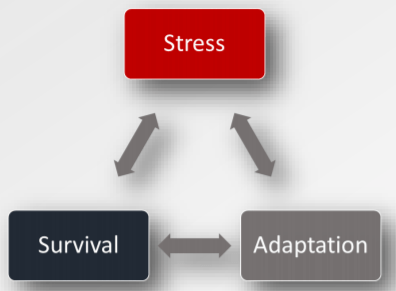
The key point here is that our bodies adapt to the stress that is imposed upon them and this stress can be manipulated through training! For example, if we want to get stronger, we apply load via resistance based training. Our body’s interpret this stress and come to the conclusion that it needs to be stronger just in case it has to go through it again in the future. It then makes itself STRONGER which means you can lift heavier going into your next session.

Another example would be, if we want to improve our “cardio” (hate that term!). For this to happen, we need to apply a particular type of stress to our cardiovascular and cardiorespiratory systems. Our bodies interpret this stress and then come to the conclusion that it needs to make the heart a little bigger or stronger and each system more efficient going into the next session. The result, you can perform better in your next session.
The point being, you need to apply the stress that you want in a particular manner to get the results that you want. You need the goal to be realistic and you need the programme to have effective structure. This allows you to keep applying the right stress in the right dosages to get the adaptations that you want to move you towards your goal.
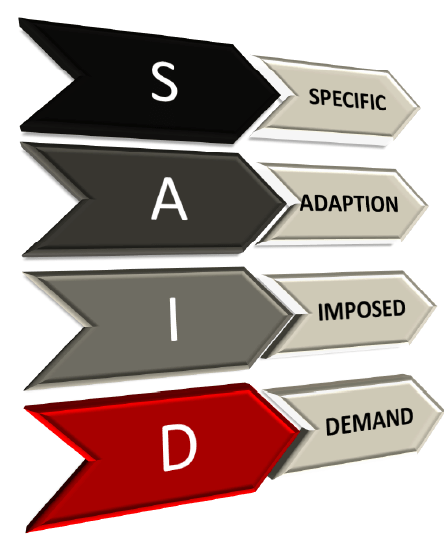
All of this is known as the S.A.I.D principle. Specific. Adaptation to Imposed Demand. Put simply, you will get a specific adaptation if you impose a particular demand on the body through.
So let’s get back to it by asking:
How can you be sure you are applying the right stress if the training session and exercises performed randomly change each time?
YOU CANT! Not really anyway!
This is because, as discussed, if the workout changes every time, you haven’t got effective structure. If you haven’t got structure you cannot be sure that you’re applying the same stress to give the body a repeated message to adapt and improve. Instead you are now giving the body mixed signals which will yield a mixed bag of results.
Worse yet, if the workout changes each time, how do you monitor the 2 key ingredients that allow you to apply the right stress? These are volume and intensity.
Think about it this way, if the training stress is the medicine, volume and intensity are the dosage. With regards to meeting your goal, you first need to take the right medicine. You next need to take your medicine in the right dosage. Take too little and you wont get better. Take too much and you’ll overdose and put yourself back. Take the right amount and BINGO, you get BETTER!
Now ask yourself, if I took a different medicine every time, would I get better? NO.
So with all of this in mind my question to you now is:
Do you still think that PT who changes the session each time is doing the right thing?
So moving on, we now know that we need:
- A goal
- Structure
- Consistency
- To adopt the principle of S.A.I.D
So all we need to know now is how to put all of this together to make the PROGRAMME.
Again, I know this probably sounds complicated, but it really isn’t. We just break it down and keep it simple!
THE PROGRAMME
All that you need to write an effective programme is written above. We just need to break the programme down into steps. They are as follows:
- The Training Day (Workout)
- The Training Week
- The Training Block
The Training Day
This is your workout and always have in mind, it’s the training day that forms the training week, that forms the training block that forms the training year. It ALL starts with the training day. So get that bit right first!
For building our training days, at Tier 1 we use something known as the R7 approach to training. In my opinion, this is the best training day system out there right now. If you want to know more you really need to look up Mike Robertson, Bill Hartman and their gym IFAST. Amazing guys, amazing coaches. I also wrote an article on the R7 once we adopted this approach at Tier 1, to take a look (CLICK HERE).
As your training day forms the foundation of everything, its important that your workout lays down the right type and amount of stress to get you moving and adapting towards your goal. Remember consistency is king, you don’t want the workout to kill you as you’ll need to be able to recover going into your next session. You do however also need to apply enough stress to ensure you get the right response.
It is in the training day that you select your training methods. If you are chasing strength, you will no doubt need to apply heavy resistance in exercises that recruit the most muscles. You will also require longer rest periods in order to recover to be able to lift heavy repeatedly. On the other hand, if you are looking to lose weight, you will most likely need to opt for exercises that again, recruit the most muscles but this time opt for longer work to rest ratios. And so forth. Once you have your training days sorted, you now put them together to form your training week.
The Training Week
The Training week is simply how you organise your training days into the 7 day week. This at first can seem tricky but think about it this way, think about your body as a bank account. Now think about your training days as trasactions. Finally think about your recovery days as cash deposits.
Your body is your bank account. When we train, we apply stress (withdrawal) upon our bodies. Our bodies then need time to recover and adapt to this (pay the money back with interest). If our withdrawals happen to much, too often it doesn’t leave enough time to pay the money back. The result is we go into debt and we breakdown. We therefore need to strike a balance.
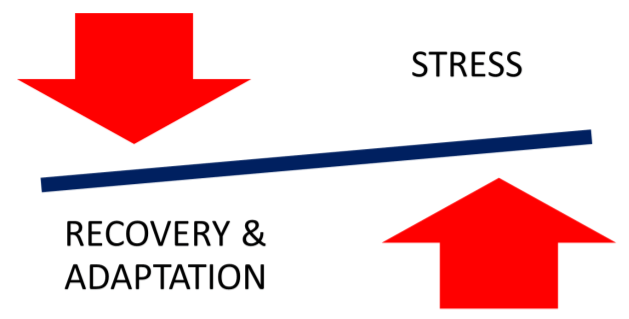
We do this by ensuring that following every large withdrawal, there is a repayment day (recovery day). This means that every high stress day (intense or high volume workouts) should be followed by a low stress day. This doesn’t necessarily mean you take the day off, far from it! Afterall, how would that contribute to consistent training!? All it means is you organise the hard training day to be followed by an easy training day. This way, you are able to train consistently in the knowledge that you are balancing out the high stresses with the low stresses. This means you are able to move from training day to training day until you have completed your training week. This means you are now well on your way to your goal!
Remember NOT every workout hast be hard! The easiest way to think about it is that on your high stress days you’re developing your body. On your lower stress days you are still training whilst giving your body time to makes the relevant adaptations from the day before!
The Training Block
Your training block is simply a series of your training weeks all progressively put together. The timeframe is determined by how long it will take until the goal of the Training Block is met. For example, the goal of the block could be endurance based and the specific goal could be to get your resting heart rate to below 60.
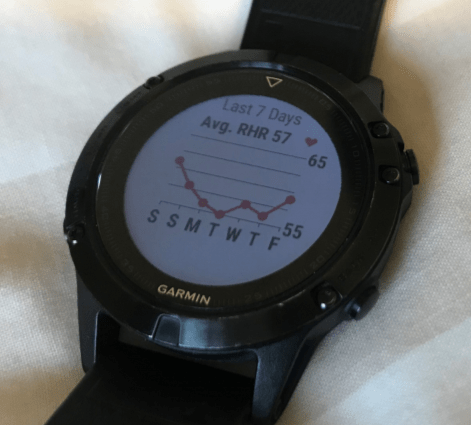
Now within the training block, each training day needs to bear in mind that in order for you to achieve this, you need to be working on increasing the strength and size of your heart. We know that in order to increase the STRENGTH of your heart, we need it to be beating fast and contracting with more force. We therefore now know that we have to get your heart rate up in order to achieve this. Therefore you will have to work at moderate to high intensity to achieve this adaptation.This therefore dictates that such training sessions impose a moderate-large stress on your heart. We therefore have just decided that this will form the basis of your high stress training days.
What we also know is that for us to improve the SIZE of your heart, we do not need the heart to beat as fast or contract with as much force in comparison. This means you don’t have to work as hard to achieve this. This type of training therefore imposes a lower level of stress upon the heart and on you. This allows us to determine that this type of training will form your low stress day.
For an example of a training method to increase the size of your heart <CLICK HERE>
And just like that we have been able to partner up your training days. Heart Strength Day (Higher Stress Day) followed by Heart Size (Lower Stress) day. For someone who wants to train 6 days per week, we can then now organise these days back to back to form their training week which includes one complete recovery day.
So how do we now set up the training weeks to ensure that we have a progressive and effective training block?
Well we know the end goal is to reduce resting heart rate through increased strength and size of the heart right? We also know that we now have our workouts organised. However, if we keep performing the exact same workouts with the exact same workloads, the body will not adapt any further. What we need to do now is manipulate the applied stress so that the heart keeps adapting. We need to manipulate the volume and intensity of the workouts after each training week. Remember we DO NOT want to change the variety of the stress!
This means the exercises that make up the training days remain largely the same to ensure the same stress is being applied. All that changes is the dosage!
So all that needs to happen is week by week, the dosage to improve strength of the heart increases a little, whilst simultaneously the dosage to increase the size of the heart also get a little bigger. However, we also know that if you want to increase heart strength, it’s the intensity that generally has to increase. We also know that for the you to increase heart size, it’s largely the volume of work that needs to increase
Therefore on your heart strength days (high stress), we need to look at increasing the intensity of the sessions (you have to produce more power!) Conversely on your heart rate size sessions (lower stress days), you need to produce the same amount of power but work for longer!).
Putting it all together
So there you have it! If we can progress the same sessions each week by simply manipulating volume and intensity and NOT necessarily variety) we can 100% ensure that we are going to improve both the size and strength of your heart and thus, easily achieve your goal of a resting heart rate that sits below 60 beats per minute!
And when would this training block end? As soon as your goal is met! We then simply set another goal and off we go again! This is now effective training!
How did we ensure all of this?
- We created a realistic GOAL
- We created STRUCTURE in the form of:
- The Training Day
- The Training Week
- The Training Block
- This created the PROGRAMME
- The Programme created:
- Accountability
- Motivation
- Drive
- All of this created the CONSISTENCY
- All of this allows you to reach your goal which makes you BETTER!
So there you have it! That’s how we do it in our world at:
TIER 1 TRAINING AND REHABILITATION SYSTEMS
Now if you have a goal in mind, all I want you to ask yourself is:
If I follow this guy or that lady….or if I buy that celebrity DVD…..or if I buy that 6 week transformation….
…will they just be working me out?
OR will they be making me BETTER!?
You decide!
Thank you so much for reading!
Best wishes,
Stuart Turner
stuart@t1trainingandrehab.co.uk
 Tier 1 Training and Rehabilitation Systems
2 thoughts on “Anyone can work you out, not everyone can make you BETTER!”